News
Members in Focus: Preeti Shetty: Sport has the power to change lives
27 November 2026
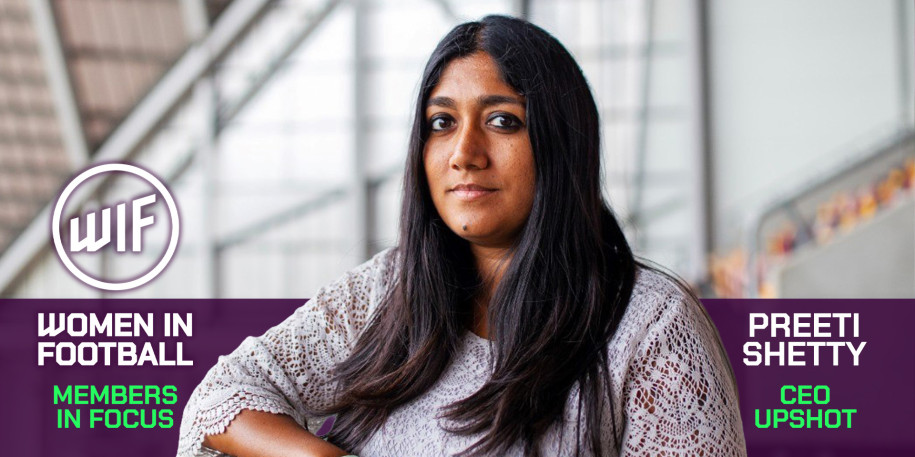
Preeti Shetty is the CEO of Upshot, a tech social enterprise that helps non profit organisations manage, monitor and evidence the community work they deliver. Preeti focuses her efforts on proving the difference sport can make to people's lives and communities through impact measurement and evaluation. We spoke to Preeti to learn more about her life and career.
Talk us through your career journey
I grew up in Dubai, the daughter of Indian parents, and lived in Belgium before moving to London to study media and communications at Goldsmiths. A four-week internship at BBC Sport introduced me to a project called BBC Your Game, that used football to engage young people. It changed my idea of what a career in sport could be.
I went on to work with organisations including Kick4Life and the Football Foundation. At the Foundation, I spent eight years helping build Upshot, its in-house monitoring and evaluation system. In 2021, I led its move out of the Foundation and became CEO of Upshot Systems CIC. That same year, I joined Brentford FC’s board. The thread through it all has been a belief in the power of sport to change lives.
What does an average day in your life look like?
There isn’t much of an average day! I might start with the Upshot team looking at a client’s data or working through how to measure the outcomes of a programme. Later, I could be speaking with a football club foundation, a youth charity or an international sports federation about the people they serve and what they are trying to achieve. Then there may be a Brentford board discussion about the women’s team, inclusion or the club’s role in its community.
The work varies, but I am usually asking the same questions: who are we reaching, whose experience are we missing, and what should we do differently as a result?

Building on their analysis of the Women in Football 2025 workforce survey, Upshot has once again stepped up to examine the Women in Football 2026 workforce survey results. As a small non-profit, WIF is hugely grateful for their continued support in this vital work.
How did you feel about the headline findings, particularly for women of colour?
I found them sobering, particularly as a woman of colour who has worked in sport for almost 20 years. I have seen real progress in who gets into football and in how openly the industry talks about inclusion. But the experiences women reported, particularly women of colour, show how uneven that progress is.
There is a difference between being welcomed into an industry and being able to build a career there without repeatedly having to navigate discrimination or prove that you belong. The value of this survey is that it asks us to look beyond good intentions and listen to what women say is happening in their working lives.
At Upshot, we help organisations turn data into insight and use that insight to make better decisions. We were proud to analyse Women in Football’s survey last year, and work with them again on this year’s results. By exploring differences in women’s experiences and looking at what may be changing over time, we can help build a clearer picture of where progress is happening and where action is still needed. It is rewarding to bring our expertise to work that speaks so directly to my own experience and the future of the industry.
Is football genuinely becoming more inclusive, or is it becoming better at talking about it?
Both things are happening. There are people and clubs doing serious work, and doors have opened that were closed when I started. But football has also become much more fluent in the language of inclusion than it is consistent in practice.
I would judge progress by what happens after the statement or campaign: who is hired and promoted, whose concerns are acted on, who feels safe speaking up, and who stays, progresses and gets promoted. If we collect evidence about people’s experiences, we have to be willing to change decisions because of it.

What’s the bravest professional decision you’ve made, and what enabled you to make it?
Leading Upshot out of the Football Foundation to become an independent social enterprise. I believed deeply in what we had built and its potential to help organisations far beyond football. But taking responsibility for the business, the team and its future was a significant step, especially when accessing investment was not straightforward.
What enabled me to do it was knowing the work mattered, having people who believed in me, and recognising that I did not need to have every answer before taking the next step.
What have you learned about using your voice as you’ve progressed in your career?
Early in my career, I sometimes felt I had to be completely certain before speaking. I’ve learned that asking the question others are avoiding can be just as valuable as arriving with the answer.
Being on a board has made that responsibility clearer. Different perspectives only influence decisions if people feel able to express them and if others are prepared to listen. I try to be thoughtful and constructive, but I no longer wait for an invitation to raise something that matters.
Which mentors have supported you on your journey?
I’ve been fortunate to have people who saw potential in me before I fully saw it myself. Some gave me opportunities; others challenged my thinking or offered honest advice when I was making a difficult decision. The most useful support has rarely been a polished career plan. It has been someone saying, “You can do this,” then helping me work out how.
A great example is Monique Choudhuri, who is on the board of Women in Football and was previously a director at Brentford FC. She pushed for the club to advertise its non-executive director positions openly, which is how I came across the opportunity. We served on the board together for two years, and her support was invaluable as I found my feet in an environment that was completely new to me.

Is discrimination improving for women of colour in football?
I have seen positive change. More women are visible across the game, there are stronger networks, and more organisations recognise that these issues belong in leadership discussions. I also know how much it matters to see someone with a background like yours in a room you had assumed was closed to you.
But visibility alone does not tell us whether women are being treated fairly once they get there. Football needs clearer routes into senior roles, fairer recruitment and progression, and a more reliable response when someone reports discrimination. Leaders should examine the experiences of different groups of women, rather than assume one headline figure or one success story shows the whole picture.
How has being involved with Women in Football supported your career development?
Women in Football has given me a community of people who understand both the opportunities and the challenges of working in this industry. Through its committees and events, I’ve built relationships with women across the game, found opportunities to use my voice and had doors opened that would have been much harder to access alone.
It also creates space for honest conversations. There is real strength in discovering that something you thought was your individual struggle is a shared experience, and that you can work together to change it.
What advice would you give your younger self, or a young woman considering a career in football?
You do not have to be a lifelong football expert to have something valuable to offer. Football needs people with skills in technology, community work, finance, research, storytelling and many other fields. Be curious about where your strengths could make a difference.
I would also tell my younger self to build relationships, ask for help and take opportunities before I felt completely ready. And if one part of the industry makes you feel you do not belong, do not mistake that for a verdict on your place in football.

If you could implement one major reform today to accelerate gender equality, what would it be?
I would make every football organisation accountable for who gets into leadership, who progresses and who leaves. That means publishing meaningful data, looking at the experiences of women from different backgrounds, and requiring boards to act on what they find.
Targets can help, but the point is to change the decisions and conditions behind the numbers. If leaders had to show how they were improving recruitment, progression, retention and pay, gender equality would become part of how organisations are run.
As WIF celebrates 20 years, why should people join the community?
Because a career in football is easier to navigate when you have people beside you. Women in Football offers connection, practical support and the chance to learn from women whose paths may look very different from your own.
It is also a way to shape the industry you want to work in. Twenty years of building that community is worth celebrating, and there is still plenty for us to do together.
Share this article

I’ve learned that asking the question others are avoiding can be just as valuable as arriving with the answer."
Preeti Shetty
CEO, Upshot