News
Members in Focus: Faye Rodgers: Trust your gut and give it your all
5 November 2026
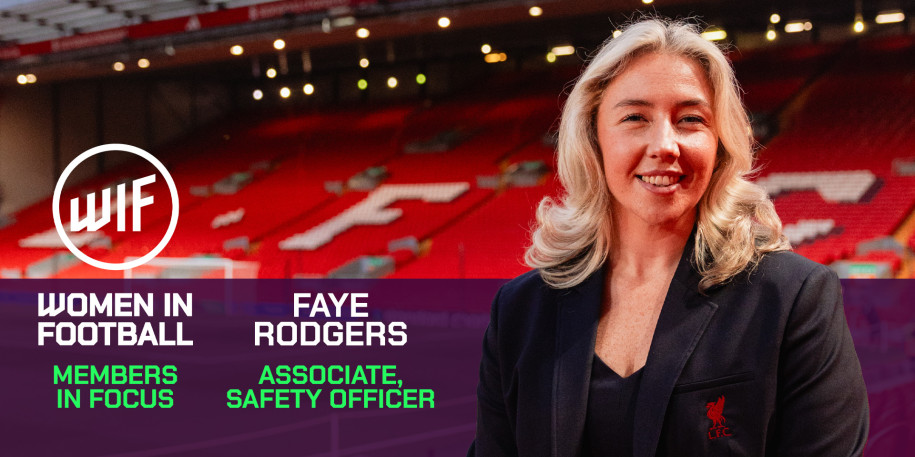
Faye Rodgers briefly considered being a lawyer, a teacher and a doctor as she, in her own words ‘bumbled’ through school. Growing up in Anfield, no more than ten minutes’ walk from Liverpool FC’s stadium, Faye unashamedly admits that football was not a major passion. Yet for more than a decade, the iconic stadium so revered by fans around the world, has been Faye’s ‘office.’
During her sixth form studies, still unsure what she wanted to do in the future, Faye took on some hospitality shifts on match days as a waitress. Once she’d left sixth form, she then took on some additional hours.
“I was very lucky, as although I couldn’t work out what my future looked like, some people working at the club saw potential in me. As well as working in hospitality, I started being offered different jobs which exposed me to other areas of the club’s operations. One of those was a two-week administration support role for the safety and security team. I never left!”
Initially supporting the team in an ad-hoc planning coordinator capacity, Faye’s line manager made the business case to formalise her role. Eight years later, she is currently an Associate Safety Officer, as well as working with the Women’s Super League as a Safety and Security Observer. So, what does her day-to-day work entail?
“For every event which has a crowd of more than 500 people, you need have to have what's called a designated safety officer” she explained. “That person is responsible for the safe and secure planning and delivery of events. For us at Anfield, our stadium has a capacity of 61,000.”
Quick to point out that planning and delivery requires a ‘small army’ and a big team effort, we asked Faye to specify some key areas that fall under her remit.
“Risk assessments, responsibility for counterterrorism and emergency procedures, evacuation and contingency plans; you’re ultimately responsible for the club section of the joined up, multi-agency blue light emergency services approach to an event. You're also responsible for running a response in a major incident, as well as traffic management, stewards and medical provisions, stadium access, turnstiles. You name it, it comes under our umbrella in one way or another.”
The identity of a match day opponent, advance weather warnings and geo-political events can also add additional variables factors when foreseeing risks. With such a vast number of operational considerations, Faye’s ‘extended family’ incorporates the club’s safeguarding, health and safety, facilities, ticketing, fan experience and communications teams. She also acts as the resident’s liaison officer, the operational and club communications point of contact for residents and Ward Councillors. “You need to liaise and engage with all those stakeholders so that as you approach a match day, everything is in place and ready to run.”

Once match day comes around, Faye’s role becomes more reactive. “As you can imagine, bringing 61,000 people, 65,000 when you add operational staff, into one area, you don’t always know what you may come across. You can plan, cross your i's and dot your t's, but once you open the stadium and run the control room, you must be constantly alert and agile.
“No two match days are ever the same, and I love that. Seeing your planning come to fruition gives me a real sense of satisfaction. For example, if we have a medical emergency, the response needs to kick into gear, and we need to get that patient to hospital. If we get feedback from the family and the doctors that this helped the person to receive swift treatment, and we did everything we could, that means the plan worked.”
Outside of match and event days (with Anfield regularly hosting music concerts too), Faye and her colleagues ensure that the club and stadium remain compliant with all legislation in place, constantly reviewing their policies and plans. As we spoke during a men’s international break, Faye explained this was a perfect time to ensure ‘all our ducks are in a row.’
Supporting ancillary events also falls under her remit, with one such example being the recent ‘Kip on the Kop’ charity sleepover on Saturday 26 September. “For this, I supported the club’s foundation with the safety, security and operational running, then I get to sleep at the stadium. That’s not always how I always choose to spend my Saturday nights, but it's for a good cause!”
In recent years, Anfield has hosted music artists from Taylor Swift and Pink to the Foo Fighters and Bruce Springsteen. Do the operational delivery and requirements for these events differ from a Premier League game?
“With football matches, you work with the FA, Premier League, EFL or UEFA, and although the requirements are slightly different, they still run very similar to each other. We work together with the event owner but the ultimate responsibility for the running of the operation still sits with us as Liverpool FC.
“Concerts are a whole different beast.
“Since I’ve been in this job I’ve been studying for professional qualifications, and one of those was in crowd management. When you have a music event at a greenfield site, you have a bit of a clean slate. You can choose where to put the stage, where to build queuing lanes and how much space it will take up. With a stadium like Anfield, you've got to work with what you've got.”
Ahead of Taylor Swift playing at Anfield, Faye’s team sat down with the promoter to understand the layout of the event, to then be able to guide them on the maximum event capacity. This includes considering how concert goers move in and out of the stadium, ensuring adequate access (with many families and children attending), to appropriate medical provision and evacuation procedures.
With concert visitors often coming from further afield, as a proud Liverpudlian, Faye gets to see people celebrate in a different way. “Often those people have never been to the city before, let alone the stadium. For a concert, everyone wins,” said Faye. With football games, there can be tensions influenced by the result, but with music, everyone is supporting the same singer or band.”
Faye also highlighted the camaraderie that exists within her field. Whereas local rivals always want to beat each other on the field, in the safety and security world, there is no competition. “We may talk about City, United and Everton in a football sense as our rivals but in my industry sector, everyone is very open to learning from each other and sharing best practice.

During the 2026-27 season, Anfield will host three Liverpool WSL games. Are there subtle differences to how her team approaches a match day?
“With the demographic of the crowd being different, that naturally changes our priorities. If a mum or dad and their child don’t know the layout of a stadium, it’s easy for someone to get lost going to the toilet. It’s a day out for many families, so with our stewards, we really work hard on simple things like wayfinding so people can eat, drink and find their seats. The aim is to ensure they enjoy the experience so much, they want to come again.”
In her role as WSL Safety and Security Observer, Faye has been impressed by how different clubs adapt their match day operations. She also admitted to finding part of the experience hard. “The idea is to give the WSL an overview of what's going on in the league. I have no operational involvement or responsibility, but I observe good practice and highlight areas of development. After a game, I always sit together with the safety officer and discuss those.
“People have always said I'm nosy and like to get involved in everything, so I’ve had to learn to be independent and step away sometimes! It has been really rewarding though to have those constructive conversations, and to also celebrate the good things too.”
Doing our pre-interview research, one social media post we found from Faye dated back to the COVID pandemic. We asked Faye for her recollections of that unprecedented period.
“When we talk about what makes Liverpool so special, it is absolutely the fans and what those ninety minutes on the pitch mean to them. It's also about the care that people have for the club, and for each other. We’ve had a gentleman whose Liverpool supporting brother sadly passed away at Hillsborough, come to the derbies. He sits in his brother’s old seat in the Kop, wearing an Everton shirt and bobble hat. No-one bats an eyelid. They know the story, the circumstances and what being there means to him.
“During COVID, that was taken away. I remember my boss telling me that games were going to be played behind closed doors and the Premier League issued guidance around what that looked like. Different coloured zones meant for example you had to have a COVID test within 24 hours or possess a vaccination certificate and have a temperature-check to enter them. My job suddenly went from focusing on the crowd, to the safe arrival of our players. The weirdest thing was when the game kicked off, you could hear the players shouting to each other.”
As football started to prepare for the reduction of lockdown restrictions, the club was first permitted to bring back a crowd of 2,000, with social distancing measures still in place. Once this number increased to 10,000, an external perimeter needed to be set up to check vaccination certificates and body temperatures. How long is it going to take per person? Have we got the equipment to do that?
“I think a mixture of the work operationally, but also the emotions we saw were what made it so special. That feeling of 10,000 fans in a 54,000-seater stadium was quite eerie, but it was a real ‘wow’ moment, realising what we had achieved together. When ‘You’ll Never Walk Alone’ was played, I honestly think the majority of fans were crying, because it mattered so much.”

During her time at Liverpool FC, Faye has participated in Women in Football’s highly regarded Leadership Programme, becoming a member of its alumna. What did she learn?
“I had heard some really good things about it and looked into the Leadership Programme unaware that the club were about to sign a partnership with WIF to support more of the club’s female employees do the same” she recalled.
“You learn so much. How to lead, how to manage, how to change and adapt your approach to your staff and to the environment. What I really liked, is that it also made you reflect. I remember going home and saying to my partner, I feel like I've just done four days of counselling. Reflecting on yourself makes you a better person, but it also makes you a better leader and a better colleague.”
After just over a decade in the football industry, does Faye feel that there are more opportunities now for women in football?
“As a young female, I’ve had experiences where I had to showcase my knowledge to prove that I was worthy of being taken seriously, but I don’t mind that. I don’t want someone to put me in a seat to tick a box. I don't want somebody to treat me differently because I'm a woman. I want to be treated on my ability, on my experience, and what I can bring.
“I've been very lucky in my work life and had some amazing male allies. Safety Officers historically have typically been retired police officers, the majority of which were male. People saw potential in me and the fact that I am a woman has been of no relevance to them. One of my former colleagues is now my line manager, Martin Woosey. He’s what we call my ‘work dad.’ Martin, alongside a few others, have absolutely been my rock in the sense of keeping me on track, keeping me humble, teaching me life’s lessons, pushing for opportunities for me and mentioning my name in rooms that I'm not in.

With time nearly up, we asked Faye one final question. What message would she give to the16-year-old girl who first started waitressing at Anfield over a decade ago?
“Try to enjoy what you do. It's not always going to be sunshine and rainbows. You do have to work hard and understand that there will be bumps in the road” she reflected. “You may think you can’t do something, or that it may not suit you, but have a go. You may be amazing; you may fail miserably, but if you don’t try, you’ll never know. Trust your own gut and give it your all.
“I’m now 27 and have almost forty years of my career left. Honestly, I have no idea where that will take me. I might keep a copy of this interview in my drawer and show my kids when I retire; me saying, I don't know what I want to be when I grow up, because I still don't! I enjoy so much what I do. I get up with a purpose, care so much about the work that I do and have huge job satisfaction. That for me, is what’s important.”
Share this article

Reflecting on yourself makes you a better person, but it also makes you a better leader and a better colleague."
Faye Rogers
Associate, Safety Officer, Liverpool FC