News
10 years of changing the face of leadership in football
26 October 2026
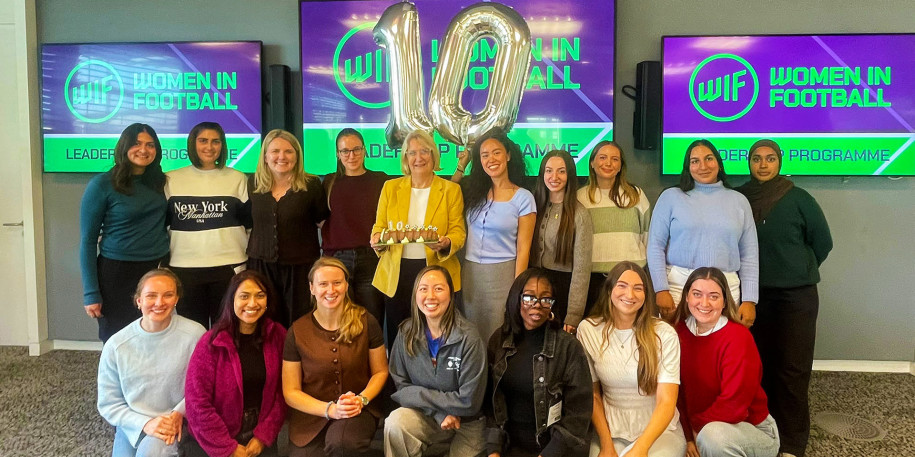
Ten years ago, the Women in Football Leadership Programme began with a simple but powerful mission: to support women to lead and progress to the highest positions in our game.
It all started with the inspiring vision of Women in Football Chair, Ebru Köksal who created the programme. Over the years, it has evolved with inputs from Ebru, Jane Purdon and Monique Choudhuri keeping content relevant and flexible to the evolving needs of women working in the game.
The programme has grown into a thriving community of women shaping the future of football. As the programme has grown, so has our network of tutors as we’ve brought together industry experts and former participants to share their experiences, insights and support women at every stage of their leadership journey.
To date, Women in Football has delivered:
-
65 Leadership Programmes
-
Supported 1,239 Leadership Programme completions
-
Delivered 2,000+ hours of leadership development
But the impact is about more than numbers. It’s the careers progressed, the networks built, confidence gained and the opportunities created.
What makes our Leadership Programme unique is that it’s taught by women working in the football industry, bringing real-life experience, sharing what they’ve learned and helping the next generation of women leaders navigate the challenges and opportunities of the game.
Ten years on, we’re proud of what the Leadership Programme has built and, most importantly, of the women who have been part of it and gone on to become advocates of the WIF community.
Hear from some of the Women in Football Leadership Programme alumnae.
“The programme gave me confidence, friendships and the knowledge to bring my whole self to work. Now I’m finding my voice, leading more strategically, and impacting the game.” – Steph Powell, National Development Manager (Volunteering), The FA

Women in Football Leadership Programme origins
From one person's vision to a thriving network, the Leadership Programme has a very personal origin for Ebru Köksal. In the space of a relatively short period, she had gone from what was probably the high point of her professional career; leading Galatasaray, opening the new stadium, being elected to the ECA Board as the first-ever woman, and receiving the Stadium Business Executive of the Year award, to a series of difficult professional and personal setbacks. Ebru’s move to the Turkish Football Federation ended abruptly after a change in leadership, leaving a role she had once regarded as a dream job, and she was simply unable to return to the position she left behind at Galatasaray. Around the same time, Ebru’s family experienced a devastating personal loss when her sister-in-law died shortly after giving birth. 'It was one of those periods in life when several things you had taken for granted suddenly disappeared at once within two years,' Ebru reflects."
In 2014, while working as a consultant for FIFA, Ebru attended Harvard Business School’s Authentic Leadership Development programme. It came at exactly the right moment. Much of the programme focused on self-awareness: understanding one's strengths, weaknesses, and blind spots; examining the experiences that shape an individual; and analysing how a leader responds when things don’t go according to plan.
She realised then, despite having spent many years in increasingly senior leadership roles, she had largely been working these things out for herself. Football did not necessarily provide the structures, management development, or honest feedback that might help someone make the transition from being a strong executive to becoming a more effective leader. Ebru recalls “I remember thinking how useful it would have been to have had some of that support several years earlier, when I was suddenly managing hundreds of people, very substantial nine-figure budgets and navigating boardrooms in which I was often the only woman.”
The programme also caused Ebru to look differently at some of her own experiences. “Until then, I had tended to regard every difficult episode to be caused by my shortcomings and as something I personally needed to overcome. The programme helped me recognise both my own blind spots and some of the structural barriers I had encountered as a woman in football.”
Most importantly, it made her think that there was little value in keeping those lessons to herself. Leadership stories are usually told through successes: the promotion, the big job, the award. People talk far less about poor decisions, setbacks, a loss of confidence, and the periods when a leader has to rebuild. Yet, those are often the experiences from which individuals learn the most. She wanted younger and emerging leaders to understand that careers are rarely straight lines. As she has described it ever since, careers are much more like a “jungle gym”. Sometimes a person moves upwards, sometimes sideways, and occasionally backwards before they can move forward again.
This became the starting point for the leadership course that Ebru developed while working with FIFA. The content combined Ebru’s own story of resilience with practical tools she wished she had been given earlier in her career, including self-awareness, understanding different leadership styles, decision-making, negotiation, influencing others, networking, and project and time management. At its heart was a very simple idea: leadership skills are not something you either possess or do not possess. Many of them can be learned, and you don’t need to wait until somebody gives you a CEO title before thinking of yourself as a leader.
Ebru’s work for FIFA and UEFA between 2012 and 2018 reinforced that conviction. “From 2014 onwards, I travelled widely delivering development work and workshops, ultimately working across close to 30 countries. What struck me was how similar the experiences of women in football could be despite enormous differences in geography and culture.”
“Women spoke about being overlooked, struggling to be heard, lacking confidence, having little access to development or mentors, and often believing that the difficulties they faced were theirs alone. That helped shape another principle that became fundamental to the WIF Leadership Programme: creating a trusted environment in which women could speak openly to one another.” The learning came not only from the course material but also from discovering that other highly capable women were grappling with many of the same issues.
On 3 October 2016, Ebru delivered the course for Women in Football for the first time with Jane Purdon as a guest speaker and Liz Ellen as a participant. It was initially a one-day leadership workshop supported by Barclays, and the response encouraged the team to keep developing it. The early programmes deliberately mixed practical skills with personal reflection and peer learning. By the third workshop in 2017, participants were describing not only learning new techniques but gaining the confidence to take the next step in their careers.
From there, the programme grew with the needs of the women attending it. “In 2018, we introduced a second level, adding confidence building, public speaking, advanced negotiation, and financial literacy to the original curriculum. In the following years, Monique Choudhuri brought her considerable expertise in leadership development, organisational culture, and people development to the programme and played an important role in helping us expand it further.” What began as a single day ultimately became a four-level programme. The first half concentrates on self-awareness, confidence, and core leadership capability, while the later stages look increasingly at leadership in action, personal impact, career progression, and board readiness.
Perhaps the element that Ebru values most, however, has remained unchanged from that first course. “We create a space where people can be honest. In football, particularly when you are one of relatively few women in a senior environment, it can be difficult to admit that you are struggling, that you do not know something, or that your confidence has taken a knock. Once people realise they are not alone, something changes. They learn from one another, form relationships and networks, and often leave seeing themselves and their possibilities differently.” That sense of connection has become as important as any individual module in the programme.
Ebru concludes that the programme has grown far beyond anything she has imagined in 2016. “Today more than 1200 women have completed the Women in Football Leadership Programme. Participants have come from across the football ecosystem, and the programme has subsequently travelled beyond London, developed new facilitators through a Train the Trainer initiative supported by the Premier League, and helped inform programmes delivered with European football partners.
"What started with the desire to share some lessons from a difficult period in my own life has gradually become one of WIF’s most important ways of investing in the women who will lead football in the future. That, for me, is probably its most meaningful legacy.”

Dedication and development
The core of the programme is built on the invaluable content shared by the tutors and the lessons learned from fellow alumnae. Yet, all of this would lose its impact without a secure, trusted space for delegates to speak openly and freely. Creating that environment requires a steady hand behind the scenes to manage administration and guide the programme smoothly. While Cate Maiolini, Membership Manager at Women in Football, currently oversees this vital work, the role was previously anchored by Sarah Gordon-Jones and Louise Matthews, both of whom helped maintain the seamless delivery of numerous courses over the years.
This steadfast support has helped the programme remain in high regard throughout its history. Often hailed as transformational by its alumnae, the course was bound to reach a point where expansion was necessary, prompting a strategic plan to future-proof its impact.
One of the most significant milestones for the future of the Leadership Programme came in early 2025, with the launch of the Train the Trainer Programme designed and delivered by Monique Choudhuri, Sarah Thompson and Nisha Vyas. Supported by the Premier League, this development was designed to build additional capacity for delivering WIF workshops.
The Train the Trainer cohort comprises Cassie Whittell, Danetta Powell, Sarah Gordon-Jones, Floss Andrews, Gaia Pretner, Lola Ogunbote, Lowri Roberts, Lungi Macebo, Michelle Dorgan, and Ruth Shaw OBE. Simply put, by equipping more women to facilitate future editions of the Leadership Programme, WIF can scale its impact and continue to elevate the careers of even more professionals across the industry.
“What a few days of learning. I feel very grateful to have learned from such master facilitators and really appreciate the opportunity. I now have a notebook filled with useful advice and am feeling excited for the next stage in this journey.” – Lowri Roberts, Sports Consultant, Play with Purpose
Investing in the next generation
As we celebrate this landmark ten-year anniversary of the WIF Leadership Programme, the focus shifts to ensuring that the next decade of leaders receives this same support. We continue to welcome conversations with forward-thinking organisations to partner with us and support the future of the programme. By backing the next phase, supporters are not just funding a course – they are actively accelerating gender equality in football, enriching the talent pool, and driving systemic change.
Over the past decade, the programme has cultivated a powerful track record of success, demonstrated by the remarkable career trajectories of the women who have moved through its cohorts. If your organisation shares our passion for developing future leaders and you’d like to get involved in the next chapter of the programme, contact the WIF team at courses@womeninfootball.co.uk.
Thank you to everyone who has made a meaningful contribution to the programme so far. We’re ten years down, and here’s to the next ten years of creating more opportunities for women to lead, progress, and shape the future of football.
Invest in yourself or invest in your team. Learn from women who work in the game, build your confidence and network, and take your next step in leadership. Find out more about the Women in Football Leadership Programme.
Share this article

What started with the desire to share some lessons from a difficult period in my own life has gradually become one of WIF’s most important ways of investing in the women who will lead football in the future"
Ebru Köksal
Chair, Women in Football