News
Members in Focus: Sade Borishade: It's about being the best version of yourself
9 October 2026
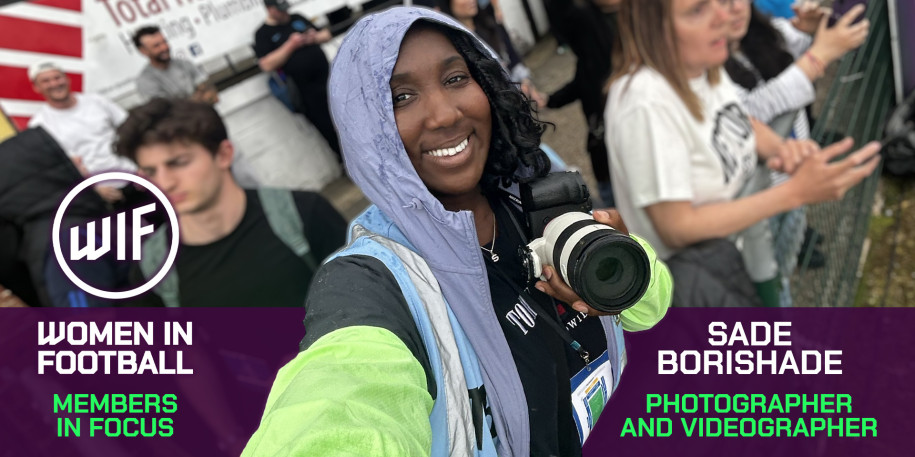
Sade Borishade is a sports and wedding photographer and videographer. Her work encompasses filmmaking, short form storytelling, brand strategy, and social media management. We spoke to Sade to learn more about her journey as a young, black creative.
You studied film, video, and photographic arts at university. Where did that interest come from?
In my first year of university, I studied social work, and pretty much hated it. It was more my mum's dream and I thought, ‘I’m going to make her proud by doing this.’ That was the goal. In the summer of 2019, I remember we had a conversation. My mum said, ‘if you don't like this, what are you going to do?’ It was such a simple, but also big question.
Straight away, my mind went to films. I love watching films and had done editing at my youth group within my church. I went on Eventbrite and found an introduction into film production workshop with a bit of advertising as well. It was here that I met a former mentor. She worked in an advertising company and asked if I’d like to meet her boss. The next day I went to an advertising company called Adam and Eve and was offered a paid internship for a month.
That's when everything took off. I was able to use their cameras and editing software and it was such a big eye-opener. I was editing things for Adidas, and a music video. I enjoyed it so much, I had a decision to make, whether to find a job or go back to Uni to get a degree.
I decided to go back and switch to film. It was 2019, going into 2020. Then we had lockdown and COVID. It didn't pause everything, but it put a hole in my learning, especially re: learning the fundamentals of being able to film. These foundational lessons that I needed to know, I had to learn off YouTube. I was self-learning, taking out equipment to practise as much as I could.
I really wanted to secure a job before graduating so I researched the best advertising companies. I started to connect with people on LinkedIn, networking, and asked if I could have a conversation with WPP about the companies under their umbrella. I had a conversation with one of the creative directors, and he told me to apply for an internship. I got to go on shoots with Ford, and it was an amazing time.
I still didn't have a job however, so I did some more networking. I met with another advertising company; McCann and they offered me a junior editing role. I was supporting the main editors when they were editing commercials, going on shoots, and on production shoots I was a runner.
I then moved to another creative agency, but in 2024 I was made redundant. Together with a friend, we founded a production company, working with football coaches and players, shooting content for them. I continued for about a year and a half, but at the end of 2025, I decided to go solo, branching out more into women’s football.

If we're not mistaken, you also were part of the Powerhouse project.
I was on the Google Pixel FC programme that supported women to break into the sports media industry and for a couple of months we got to visit the BBC, ITV, and Google. We went to Liverpool FC to interview some women’s players and that experience gave me the confidence to think I could do this. However, at the back of my mind, I had the feeling that because I'm a black woman, this may be a barrier. I saw so few women that looked like me.
It never stopped me from pursuing my path or networking, but when we went to ITV, I wanted to know how the hiring process worked. I know there is something called ‘the diversity hire’ which I find a bit offensive. Are companies just trying to check a box as a statistic, rather than looking at someone’s work and providing opportunities on merit?
On a workshop in April facilitated by BCOMS, you posted that ‘people are getting bored of the same narrative being told and shown via the same demographic of people who haven't experienced different cultures and perspectives’ and that you want to ‘inspire the next generation of photographers and storytellers.’ How do you hope to do that?
I first got the opportunity to shoot at Chelsea thanks to BCOMS. Had I not been on the programme, I wouldn't have known how to get there myself. There is an unclear pathway for photographers, and that is something I would love to see change. Being a photographer is such a competitive industry and for the WSL, there are usually only 20 to 30 at each game, depending on the size of the stadium.
When I went to that game, I was so excited, yet when I looked around, I didn't see any other black women. I get Instagram messages and DMs saying, ‘how do I get to do what you’re doing?’ Or ‘I saw you at a Chelsea match. That's so cool.’
Visibility is so important. People like Ann (Odong, legendary Australia women’s football photographer) have been doing it for years now, but she also had to go through the same kind of battles. I am now building a network of female photographers of different ethnicities, and I'd love to keep shining a light on this subject. I hope the decision makers, governing bodies and clubs are going to make the pathway a bit clearer.
I would love to deliver workshops to help women who want to get involved in sports photography. As well as technical topics, I would also talk about things like personal branding. It’s not just about ensuring your portfolio looks great, but also about putting yourself out there and seeing what opportunities are available.
Having the confidence to go and shoot a football game, preparing for the intensity, is not easy. Based on what I've heard from my community, not just black women either, that is where the fear comes in, because you're out there alone.

How did your path cross with Ann Odong, bearing in mind the distance between East London and Australia?
It's funny because I had no idea who she was! Ann commented on an Instagram post of mine that went viral, of me talking about representation. It was one of the first posts that I did. Ann emailed me and introduced herself. As soon as I realised her journey, I knew I needed to have a conversation. We had a two-hour chat, and my story resonated with her; what I'm trying to say and how I'm trying to say it. The programme she helped set up with Sony, where she supports young women to get an internship shooting women's football, is a great initiative. I wish clubs and corporate organisations in the UK would back things like that.
If people or organisations are willing to see the vision, we can switch up storytelling, rather than keep telling the same stories from the same angle, as has happened for years now. I think we'll get there... somehow.
What does an average week look like for you? What are the different skills you need for such distinct types of photography?
With weddings, there is just as much pressure as in sport. You must be equally observant, whether you're looking out for the shedding of a tear, or someone putting their hands on their head as they've just missed a goal. There is always a story to pinpoint.
Day-to-day, I'm usually editing a shoot that I've done, whether it is videography or photography. I've got four wedding films to finish this week, plus I am on a podcast.
I use a programme called Photo Mechanic which Ann introduced me to. Getting your mind wrapped around metadata and the organisation of your files, feels a bit like coding. If not for Ann, I would not have known. I just thought, oh, you take nice pictures, put it on your portfolio and you sell it and that's it! There is a whole other world, and I'm learning every day.

Which club or organisation are you inspired by currently?
Sometimes it is uncomfortable, being one of the only black female photographers out there. That’s why I do the content that I do. Sports photography does lack representation. I think representation and authenticity feeds culture.
The best example, and it's so amazing, is Arsenal. Arsenal incorporates fashion, music, and a lot of other things into their content. They are probably the most diverse football club I have come across in the UK.
Their content doesn’t feel like a diversity box-tick, and I’m sure in terms of merchandise, they are increasing money coming into the club via their content. They are connecting with such a broad spectrum of people. I support Chelsea, and I’d love to see that same kind of ecosystem celebrating diverse cultures authentically too.
What is the biggest challenge you have faced and what did you learn from it?
I am 27 years old, and my background is from a single parent household. I saw my mum work two or three jobs at a time, just to take care of me and my brothers. So that culture of working hard and not giving up is ingrained in me.
When I think about the rejections I have encountered, it's always been important not to let smaller issues snowball into something bigger. When I took a job as a runner, I knew that I could do something more, but I threw myself into it. I took contact details from the camera operators that were on shoots and met so many creative people, producers as well. If you're able to connect with producers, they will remember you, which is important. It's about being intentional on how you work and not giving up.
I once saw a quote that said ‘you're too broke to not be visible’ from a motivational speaker and business owner called Hayley Mulenda. I was like, ‘this makes so much sense.’ It is important to have a portfolio, but if your network is not great, unfortunately, it's not good enough.
There is an invisible ladder that you must work your way up. But how do you start, and how do you keep motivated? For me, it is creating content, connecting with people, and receiving comments saying, ‘this has helped me so much’ or ‘thank you so much for the advice that you're giving.’ I try to make it really clear in my content that I am not the expert. But by showing you what I've done, and by people being able to understand, I think it has helped people.
Someone from Australia recently messaged me and thanked me for the step-by-step advice I had provided. He’d just finished a photo shoot for an Australian team, and then worked with one of the national teams, because of how he had networked. He was saying that it was due to my content. For me, that was a real ‘wow’ moment.

What would you like to see improve to support young creatives from ethnic minority backgrounds?
Most companies are investing in the mental health side of things of the job, which is great. However, I think there could be more shadowing opportunities, enabling people to experience the role they may want to get into. To shadow someone and be able to know what that role is like, could be invaluable.
If I work at a club and am the person that sorts out the photographer accreditations, maybe I could also organise a shadowing experience for people to learn how to shoot a game. These kinds of things would make such a significant difference.
What piece of advice would you like to share with someone hoping to follow you?
I want to make sure that I give people the best impression of me. Not just by the things that I do, but who I am as a person. I think if I do that, then doors will open. It's about being the best version of yourself for people. Be the best person that you can be.

What is it that you love the most about photography?
I think if you like to tell stories, photography is the best way to do that. When you're in different environments, there's so many stories to tell and you're in the best possible place to do it.
There are people who can write about what they saw, but you're visually able to see a moment and capture it. That is the coolest thing. People will remember a moment because of a picture. You're getting to tell that story to thousands, maybe millions of people. We live in a digital world, and people want to have the same kind of experiences. Because of a photo or because or a video, they’re still able to ‘live’ that moment, even if they were not there.
Some people may not want to get into sports photography because they’re unsure how they can make a living from it. You can work for an agency or go freelance and could earn a lot if you work hard. You could also become one of the best storytellers of your time. Maybe. Let's hope!
You can follow and connect with Sade via Instagram, LinkedIn or via her website.
Share this article

There is an unclear pathway for photographers, and that is something I would love to see change."
Sade Borishade
Sports and wedding photographer and videographer