News
Members in Focus: Helen Ward: If you're doing something with a smile on your face, you're in the right place
11 August 2026
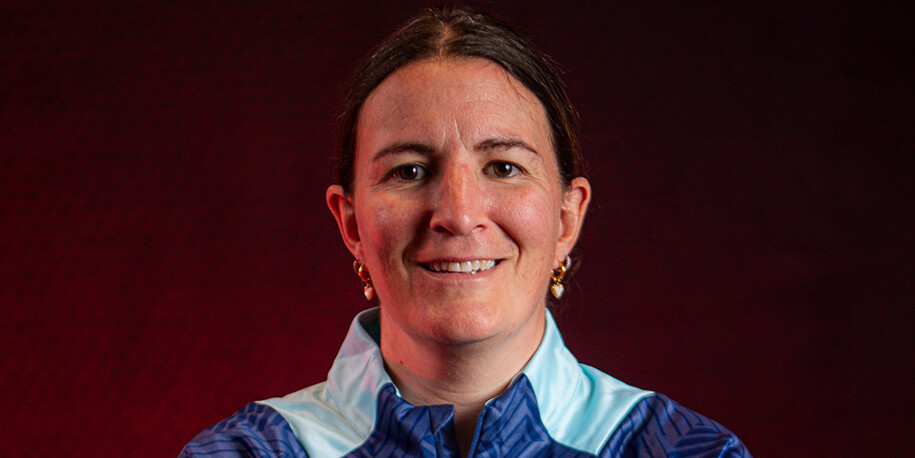
Very few footballers have a mural of themselves at a stadium. In the case of Helen Ward, the recognition at Watford’s Vicarage Road follows a career synonymous with goals. Lots of them.
Born in the same London borough that is home to Wembley Stadium, Helen had spells at Arsenal, Chelsea and Reading. But it was at Watford - scoring 161 goals in 199 appearances for the Golden Girls – and 105 caps and 44 goals across fifteen years for Wales (second on the all-time top scoring chart) where she was most prolific.
As a child, Helen’s mum, dad and older brother regularly played sport, so she would spend her weekends watching them in action. She told her mum she would never get into competitive sport. Then her brother inadvertently intervened. After Chris brought home an advert promoting a training session for young girls, Helen’s first taste of the game was in a school hall. The next weekend aged just nine, she played in a tournament, scoring a hat-trick on her debut.
What would Helen have done had her football talent not shone through? “My mum and sister were teachers, and as a kid, that idea scared the life out of me. Knowing what I know about myself now, it would have been something like caregiving, trying to impart wisdom on people in some way, whether they wanted it or not! As I got towards the latter part of my playing career, I always wanted to help others.”
Three summers ago, Helen hung up her boots at the age of 37. When asked if she is surprised how quickly the domestic game in England has changed, her answer was unequivocal. “The difference in finances is extreme,” said Helen. “Transfer fees were not a part of the women’s game when I was playing - at least they were certainly not public - and now we’re seeing some clubs, even in Tier 2, spending big sums on purchasing players, and on wages.
“It's not perfect. There are still players and clubs not blessed with strong financial backing. Getting paying fans though the gate is another challenge for a lot of clubs. The fact some clubs are now building training grounds for women's teams or building bespoke stadia is great. I think it takes the top end of the game to ‘stretch’ things and to bring everyone along. My only concern is that you don't want it to stretch so far that it breaks, therefore some clubs can't keep up.”

Within a couple of months of retiring, Helen stepped into the role of Watford FC Women General Manager, now Head of Women’s Football. What does her average work week look like?
“The responsibilities depend on the number of people you have around you” explained Helen. “For the last three years, everything that doesn't happen on the pitch: that’s me. I’m responsible for the recruitment of staff, from creating job profiles, through to interviews and the hiring process. I order the kit nine months in advance too. That’s a real challenge because you don't know how many players you will have, nor their sizes.
“Other elements of the day-to-day running of the club are also down to me. That includes distributing training schedules for the players, organising training sites, as well as buses, hotels and catering for away games. I also attend different events, speaking to people who may be interested in becoming a partner or sponsor. It’s my dream in future to invest more time in driving the strategic, longer-term planning as we aspire to reach WSL 1.”
When Helen returned to football after the birth of her daughter, she was only offered a part-time contract as the club in question assumed that she would not be able to manage full-time training. Have her own playing experiences influenced the way she works now?
“I'm not bitter about some of the things that happened” she reflected, “but I wouldn't like to put anyone else through the same thing. Attitudes towards maternity support and parenthood have changed significantly and I'm a massive champion of women having children during their playing career. I don't think I would have played so long if I hadn't had my kids, as it gave me a different sense of perspective. But I'm very aware it isn't easy if someone doesn’t have the same support network that I did.
“I also recall situations where, as a player, I’d ask a question of somebody in the position I occupy now and get a sense I wasn’t being told the whole truth. I think there should be honesty in communication. I see the game from a business perspective now. The players know the decisions I make are for the best interests of the club and I’m trying to do what's right.”

Doing what’s right also extends to the environment that Helen and Head Coach Renée Hector have been cultivating. All Blacks mental skills coach Gilbert Enoka famously introduced a policy that weaned out inflated egos; players who put themselves ahead of the team. His motto was: if you can’t change the people, change the people.
Helen credits former Golden Girls coach Damon Lathrop with first instilling a fresh culture where the focus was on staff and players coming to work and enjoying what they were doing. He reasoned that if people were happy, they would do their jobs to the best of their ability.
“I want a player to feel that they're being seen as a person, that they feel secure and supported,” said Helen. “I'm not saying every person walks into the building every day with a big smile on their face. But I hope everybody knows we care about them as people first and foremost. We're going to do a lot of work this summer in recruiting the right staff to support that, to make sure everybody is okay physically and mentally, on and off the pitch.
“In our club culture, even down to the way we play, there's never any blame. Last season, if someone mis-placed a pass because they were trying to play the way we asked them to, they knew they were never going to get shouted at. I think this philosophy - not only our playing style, but in how we encourage players to learn and express themselves - got out there, as word spreads quickly in this industry. Hopefully that helps us to attract the right people we’re looking for as we move forward. Not everybody is going to be best friends or want to go for a coffee or a beer together. But it’s vital that you respect and help each other.”
If you spend more than a few seconds in Helen’s company, you quickly note her desire to shift any form of recognition away from herself. In a notoriously male-dominated sport, we asked her about the importance of male allyship, and whether there was anyone she was keen to shower with e-flowers. One of her answers, was particularly poignant.
“Chris Buxton was the only male teacher at my school when I first started playing. He sadly passed away a few years ago, but what he did, was probably the first time where somebody protected me, without me knowing it. I only found out after he died that he used to have arguments with opposition schools about having girls on our team. He asked why it mattered. He wanted us on his team. Hearing that in hindsight was really special.”
Another ally was Rich Walker, Watford FC’s former Head of Communications. “Rich wasn't picking the team, but he wanted to bring me home” recalled Helen. “I told him: I've got two children. I need to find a way that I can support them as a mum, support them financially and be able to give my best as a footballer. He essentially created a job that fitted around the kids and football. Right until last summer when he moved on, he was a constant pillar of support and showed huge faith in me. Even now, I'll call him up and he'll give me advice on certain things.
“Paul O'Brien, Chief Commercial Officer at Watford (who departed the club in mid-July) was also a huge shoulder for me to cry and lean on. He helped me work through a lot of things last season. They are two very important people who supported my professional development, who I can also count as friends.”
In September 2025, Women in Football’s annual football industry workforce survey highlighted barriers and behaviours that still confront women daily. In one key finding, 86% of women believed they must work harder than their male counterparts to achieve the same recognition and benefits, while only 69% of men surveyed agreed with them.

Having been involved in the sport herself for a quarter of a century, does Helen see progress, or is there still a long road to travel for women working in football? “I would say at the top table in a lot of organisations and clubs, there still feels ‘a job for the boys vibe.’ We are getting more women and a lot more diversity on the ground in coaching, backroom and administrative support staff roles; anything that sits under senior management. But when you get to that senior level, it still feels male dominated.
“Until there is significant change, it's going to be difficult for women to progress. Within women's clubs, more women are in senior roles, but you don’t see this across the industry. I don't want people to get a job just to tick a box. You shouldn’t have to have a woman on the board. But you do want opportunities and not have to go above and beyond to prove you're worthy, which feels the case sometimes.”
In September 2024, a new statue honouring Welsh suffragette Lady Rhondda was unveiled in Newport in recognition of her 40-year campaign for women to be allowed to sit in the House of Lords. The statue also features a circle of clasped hands, cast from the hands of around forty present-day women, who fought for equality. Among those forty women is Helen. Who would she choose to cast in bronze, if there was an opportunity to commission a statue to an unsung hero of the women’s game?
“Vic Akers straightaway came to my mind. I always think the stars must have aligned in some way that he happened to be at Arsenal (as Kit Manager for the men’s team) and started the women’s team. Vic is why the club are where they are now. He created something that went beyond the players on the pitch. He got everybody within the club to believe in what he was doing, at a time when women's football was nothing. I think a huge part of women's football today is down to what Vic Akers did in creating that team. I don't know if is there a statue of him? But there probably should be.”
In Wales, Helen referenced current UEFA Vice President Laura McAllister, a hugely respected voice in European football who fought to get the women's national team recognised by the FA of Wales. She also highlighted her former teammate and coach, Jayne Ludlow.
“Jayne put herself and her own career on the line internationally because she wanted more for the team and for women's football in Wales. It's probably something in hindsight people didn't really see at the time. They maybe saw someone throwing their toys out of their pram, who had everything at Arsenal,” said Helen. “Jayne should have had hundreds of caps for Wales, but she was willing to sacrifice that to speak up for what was right.
“I'm not condoning some of the behaviour at times, and I'm sure she won't mind me saying that. There are certain things she said and did, that maybe she would have done a bit differently. But some of the decisions and choices she made were because she wanted Wales to be better and she wanted the association to treat the players and the programme with respect. A lot of the structures in place today were influenced by her.”

Despite Helen’s on-field achievements for Wales, one of her finest moments involving the national team was watching them qualify for their first major international tournament - Women’s EURO 2025 - from the BBC commentary box. During her second pregnancy, Helen completed a degree in Professional Sports Writing and Broadcasting at Staffordshire University, graduating with First Class Honours. How important was adding another ‘string to her bow’ before her playing career finished?
“We are probably seeing the last of the generation of players that had to work alongside playing, or at least did at the beginning of their career. When your career finishes, you go from having twenty to thirty teammates and staff you see every day, to everything changing. Football will move on without you. How many people in that group can you really rely upon? How many of those people will remain in your circle for you to lean on for support, or for social interaction?
“Football can be a very stressful environment. Something away from the game is good for your mental wellbeing. I'm keen to make sure players think about what they are going to do when they finish. What is it that takes your mind away from football? Who can you be with? What is it that will ensure you're not going to go home and just sit on your own for hours until the next day's training?”
Before our interview wrapped up, we had one final question. What piece of advice or motivational mantra would Helen share with a young woman coming into the football industry?
“When Emily was a toddler, I had returned to playing, was studying for my degree, and pregnant with Charlie. Someone said to me, how do you do it all? I had a think and simply said: because I want to. I realised that if you want to do something, you'll find the time. Not find excuses.
“I've always gone back to that and asked myself: am I trying to find excuses not to do something? If so, move on. I now say this to the players and staff. If you find yourself as a player making excuses and not wanting to train or play, you're probably in the wrong place. You may not need to give up football, but you may need to move and try somewhere different.
“If you're doing something with a smile on your face, finding the time to do the extra training, and finding time to look after yourself, you're probably in the right place. You're going to perform a lot better, whatever it is that you're doing.”
Share this article

My daughter Emily was a toddler, and I had come back to football. I was studying for my degree, and pregnant with Charlie. Someone said to me, how do you do it? I simply answered: because I want to.”
Helen Ward
Head of Women’s Football, Watford FC