News
THEY/THEM/SNICKERS: HOW TO BECOME A MORE EXCELLENT HUMAN ON INTERNATIONAL NON-BINARY PEOPLE’S DAY
14 July 2026
‘Ladies and gentlemen,’ begins the host, welcoming us to the event. Being neither a lady nor a gentleman, I’m immediately feeling slightly less welcome than most other people in the room.
Don’t get me wrong. Non-binary people don’t spend our whole lives being ‘offended’ by things like this. We understand why it happens. The gender binary is ingrained all around us – not just in the cut of our clothing and the layout of our lavatories, but in the very structure of our language. And the structure of our language shapes the way everyone thinks. We get it.
So when the conference begins like this, it’s not the end of the world. The host seems like a really nice person and I know she’s not doing it on purpose. I get through the day without any kind of emotional breakdown (at least until several hours later, in the evening, when I check my phone to see how Grimsby Town are getting on) and the event is great.
As Women in Football’s Communications Manager from 2021 to 2026, nearly all of my working time was spent in spaces which people had taken care to make inclusive. I met a good many people who made me feel entirely comfortable with who I am. Some of them were even men. The difficult times, when they happened, were difficult not because of a single, terrible incident of the kind I know many women still experience in the football industry, but because a number of ostensibly minor circumstances or occurrences could add up over the course of a day.
I don’t know if ‘micro-exclusions’ is a word, but it feels like it’s in the right ballpark to characterise these small but cumulative episodes of binary gatekeeping. The gendered introduction from the host. A weird look or a double-take. That time in the function room at Bramall Lane when some guy told me I was heading for the wrong toilets. From time to time these kinds of episodes can pile into one another, and make me feel I don’t belong.
So if you want to make non-binary people feel seen, included, and genuinely welcomed – and what decent person wouldn’t? – then you might want to give a bit of thought to how to avoid micro-exclusions (I’ve decided it’s a word now; you’ll just have to deal with it). Here are some pointers that could be useful.
You can’t tell just by looking
You already know that plenty of women and men don’t conform to the stereotypes of their assigned gender, but they’re still women and men. Similarly, just as some non-binary people might have an androgynous appearance, plenty of us also present like regular women and men.
Generally speaking, then, you can’t really tell whether someone is non-binary just by looking at them. Exceptions may apply if, for example, someone’s wearing the beautiful colours of the non-binary flag, or a T-shirt that says I AM NON-BINARY, in which case you can probably assume that they are non-binary.
Avoid binary-gendered language
Yes, it’s a hard habit to break, but if the world can say Snickers instead of Marathon then it shouldn’t be impossible to say ‘hello everyone’ instead of ‘ladies and gentlemen’. There are entire subreddits devoted to alternative terminology – and personally I find ‘guys, gals, and non-binary pals’ kind of cute, but if you’re starting to talk to a room of people then why bring gender into it at all? ‘Hi, folks!’ is perfectly OK, or ‘hello and welcome’ if the vibe is more formal.
That’s how it works when you’re talking to the room, but how do you avoid gendered forms of language when you’re talking or referring to individual people? PSA: there is never any need to say ‘he or she’ – if you need a pronoun for a single person whose gender could be anything, they is absolutely fine. And please don’t call me ‘sir’. I know you’re doing it to try and be polite, but in essence you’re just speculating about my anatomy, and when you think about it, that’s actually quite rude. (Also, ‘sir’ has a subtext about social class and subservience which is genuinely icky).
Thirdly, if you’re collecting personal data in a form, be certain to include ‘non-binary’ as an option in the gender field. If you absolutely have to ask for someone’s title, make sure you include Mx – the handy non-binary identifier for people who haven’t received PhDs, served in the military or been ordained to the Church!
Rethink dress codes
We’ve all been appalled, and quite rightly, at those employers that think it’s still 1974 and they can order their female workforce to wear heels. But almost every dress code embodies and enforces the gender binary. Wearing a shirt and tie has always made me physically and psychologically uncomfortable, but it’s only recently that I’ve realised the reasons: the shirt and tie combo is part of a predominantly male-coded dress style, and if you make me wear them then you’re forcing me to deny my identity.
So does your workplace or event really need a dress code? No. Are you going to insist on having one anyway? Avoid ambiguous phrases like ‘business casual’ – if you don’t want people to wear jeans or trainers, just say ‘please don’t wear jeans or trainers’ – and please don’t prescribe different requirements to different genders. Most people will dress according to their assigned gender without you having to insist on it, and not insisting on it will make non-binary people more comfortable.
Normalise the sharing of pronouns
Put them in your social media bio. Put them in your email signature. Get everyone in your organisation to put them in their email signatures. Put them on delegates’ name tags. Spread them on your toast. Honestly, the more you normalise the sharing of pronouns, the more normal non-binary people feel.
Not sure what pronouns are, or want to know more? Stonewall have got you – check out their guide.
Don’t be afraid
Writing pronouns everywhere is easy, but remembering to use the right ones every time is hard. Non-binary people understand this; hell, sometimes we even misgender ourselves. So we will not curse your bloodline if you make an honest mistake. We’ll just be sad if you don’t even try. When you get it wrong, don’t make a huge deal of it – just a quick ‘sorry’ is best.
By the same token, if you’re curious about it, we will usually be happy to discuss the Whole Non-Binary Thing (which I haven’t tried to do here, because the Women in Football website only has so many terabytes of server space). Just be tactful and empathetic. Don’t ask someone about their anatomy – that’s not only rude but quite weird – and don’t immediately jump into an interrogation about toilets. Try a question like ‘is it OK to ask something about your gender identity?’ and see how it goes. If the other person says no or seems awkward, just back off. You can ask me instead if you like.
I always knew I didn’t belong to either of the two binary genders, but it’s only as an adult that I’ve come to fully understand and love this aspect of my identity. Knowing about and acting on the points I’ve raised here will make you a more excellent human being – but even better than that, you’ll also help other non-binary people to be at peace with themselves and the world. Thank you and happy International Non-Binary People’s Day!
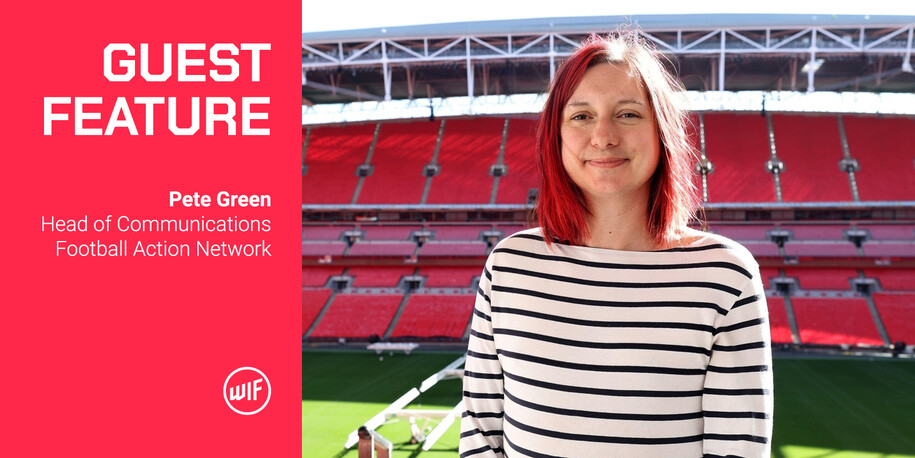
Pete Green [they/them] is currently working as Head of Communications at Football Action Network and as a freelance communications and content specialist. You can connect with them on LinkedIn here.
Share this article

The more you normalise the sharing of pronouns, the more normal non-binary people feel."
Pete Green
Head of Communications, Football Action Network